
Restoring Guardrails and Accountability for Memorandum and Balancing Accounts
Part 3 of a three-part series
Introduction – Turning to Solutions
Customers should only pay for utility costs that are reasonable, justified, and necessary to provide safe and reliable service.
This blog is the third and final installment regarding regulatory mechanisms called memorandum and balancing accounts. Our first blog explains how memorandum and balancing accounts work within California’s utility ratemaking framework. The second blog examines how these accounts have expanded beyond their original, limited purpose and what that means for customer bills, affordability, oversight, and cost discipline.
This final blog turns to the central policy question: what guardrails are needed to protect customers?
Memorandum and balancing accounts were intended for use in limited circumstances, including when substantial costs are unforecastable, outside a utility’s control, or difficult to predict with precision. But their current scope and scale show why they need stronger limits. These accounts should not become a mechanism to bypass forecast-based ratemaking conducted through the General Rate Case. The General Rate Case is the process by which the California Public Utilities Commission (CPUC) considers a utility’s proposed budget for a 3- or 4-year period. Once the CPUC approves the budget, a utility can then collect its revenue requirement from its customers through their monthly bills.
Stronger guardrails and better transparency are needed to ensure these types of accounts are not exploited to the detriment of customers. And there must be meaningful consequences when utilities seek recovery of costs that customers should not pay.
Forecastable Costs Should Be Addressed in the General Rate Case
The General Rate Case process should remain the primary forum for setting utility budgets.
That is where utilities forecast expected costs, justify proposed spending, and have those costs reviewed as part of a broader budget before customers are asked to pay.
When costs are reasonably foreseeable, recurring, or within the utility’s control, they should generally be addressed through the General Rate Case process rather than allowing the utility to incur costs that are then tracked separately in a memorandum or balancing account, also known as tracking accounts.
This is especially important for costs that are no longer rare or isolated. Wildfire mitigation, vegetation management, infrastructure hardening, and operational costs may vary year to year, but are recurring fundamental parts of utility operations. When these costs can reasonably be forecast, they should be considered in the General Rate Case process.
Returning forecastable costs to the General Rate Case helps instill utility cost discipline. It also ensures that these costs are evaluated alongside the rest of a utility’s budget, rather than separately.
Current proposed legislation, SB 1098, authored by Senator Sasha Renée Pérez (D-Pasadena), recognizes forecast-based ratemaking through the General Rate Case process as the preferred approach for setting electric and gas utility revenue requirements and would require additional findings when memorandum and balancing accounts are authorized or maintained.1
That framework reinforces a core principle: these accounts should be limited exceptions, not routine substitutes for the General Rate Case process.
Clearer Standards Are Needed for When Regulatory Tracking Accounts Are Created
Not every cost that varies over time should qualify for separate tracking. And not every cost increase should be shifted outside the normal General Rate Case process.
Before authorizing a new memorandum or balancing account, regulators should require a clear showing that the account is necessary. At a minimum, the utility should have to show that the costs to be recorded in the account are substantial, difficult to forecast, outside the utility’s control, and not already addressed through the General Rate Case.
The authorization should also define how long the account should remain open, how recovery of costs recorded in the account will be reviewed before any of the costs are included in customers’ rates, and when the account will expire.
Increasingly, tracking accounts that begin with a narrow or limited purpose can become long-running cost recovery mechanisms for broad categories of utility spending. A set expiration date or reassessment requirement would help ensure the CPUC regularly reviews whether the account is still needed.
Accounts Should Be Reviewed in Context, Not in Isolation
Memorandum and balancing accounts are often reviewed account by account and in separate CPUC proceedings. This piecemeal approach can obscure the cumulative impact on customer bills of multiple pending requests.
The scale of these accounts is significant. A 2023 California State Auditor report found that, as of December 2022, the four major energy utilities maintained more than 300 balancing accounts with more than $16.9 billion in cumulative balances. Of that amount, $10.9 billion reflected undercollections – costs utilities had tracked but not yet collected from customers – which could create future rate pressure if approved for recovery. The remaining balance reflected overcollections, which generally indicate amounts that may need to be refunded or credited to customers.2
Figure 1. Major Energy Utility Balancing Account Balances as of December 2022
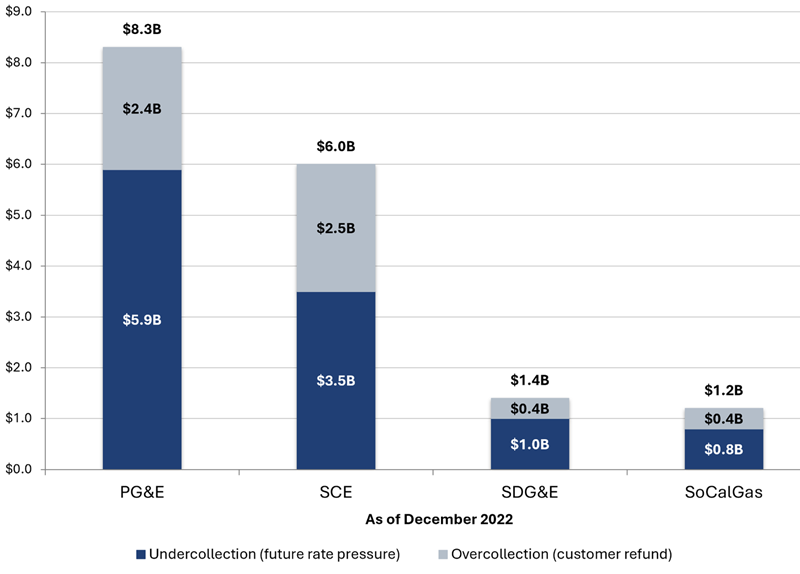
Source: Recreated from Figure 14 in the California State Auditor’s 2023 report, Electricity and Natural Gas Rates. The original figure reports balances in millions; values shown here were converted to billions and rounded.
Regulators, policymakers, and the public should be able to see the full picture of the costs a utility is seeking to recover from its customers, including:
- the number of active memorandum and balancing accounts;
- the balance in each account;
- how long balances have been accumulating;
- when utilities expect to request recovery;
- whether costs overlap with amounts already authorized elsewhere; and
- the combined impact on customer rates.
This type of information would make it easier to understand whether these accounts are being used narrowly and appropriately, or whether they are becoming a shadow cost recovery system.
Stronger Justification Is Needed Before Customers Pay
Recording costs in a memorandum or balancing account should never mean those costs are automatically recovered from customers.
Before customers are required to pay, utilities should have to show that costs were actually incurred, reasonable, incremental, within the scope of the account, not already funded elsewhere, and supported by adequate documentation.
These concerns are not theoretical. The Public Advocates Office has repeatedly identified costs in utility requests that customers should not have to pay.
In a recent water utility proceeding, our office found that Suburban Water Systems recorded some expenses in both its regular accounting records and a memorandum account. That created a risk that customers could be charged twice for the same costs if the duplication was not identified and corrected.3
Our office has also found political and advocacy-related costs booked to accounts that were presented to the CPUC for recovery from the utility’s customers. In SoCalGas’ Test Year 2024 General Rate Case application, our testimony showed that SoCalGas initially booked costs for political campaigns to ratepayer accounts, including efforts to influence transportation, port, airport, CPUC, state, and local decision-making. The testimony also found that SoCalGas paid an organization to produce speakers at public meetings without clearly disclosing SoCalGas’ role. Those costs should not be paid by customers.4
These examples show why review of costs after the utility has incurred them is not enough. When billions of dollars are spread across accounts, subaccounts, workpapers, and proceedings, identifying improper costs is like searching for million-dollar needles in billion-dollar haystacks. Customers should not have to depend on regulators and parties finding every improper cost after the fact.
Utilities Need Meaningful Incentives to Get It Right the First Time
If a utility records inappropriate costs in an account in which the costs are proposed to be included in customers’ rates, and the only consequence is that the costs are disallowed if someone finds them, the utility does not have enough incentive to prevent the problem in the first place.
In that scenario, the risk is asymmetric: if the improper cost is discovered, the utility does not recover it; if it is not discovered, customers will pay for those costs. This is not real accountability.
Strong guardrails should therefore focus not only on reviewing costs after they are recorded in a tracking account, but also on creating meaningful consequences when utilities seek recovery of costs that customers should not have been asked to pay.
This need for accountability is currently being considered by the California Legislature.
AB 2065, authored by Assemblymember Cottie Petrie-Norris (D-Irvine), would address this accountability issue by requiring the CPUC to disallow prohibited costs from customer rates and impose financial penalties when utilities record those costs to ratepayer-funded accounts. This includes costs that are already barred from recovery, fall outside the scope of an authorized account, or have already been approved for recovery elsewhere.5
That type of accountability matters because disallowance alone is not enough. Utilities should be required to screen costs before seeking recovery, and they should face meaningful consequences when they fail to keep prohibited costs out of ratepayer-funded accounts.
Transparency Should Be Built Into the System
Transparency should not depend on customers, advocates, or policymakers piecing together information from separate CPUC proceedings.
Utilities should provide clear, regular information on active memorandum and balancing accounts, including why each account exists, why the account is still needed, how much has been recorded, how much has already been recovered, and what customers may be asked to pay in the future.
That information should be easy to compare across accounts so regulators and the public can see whether costs are accumulating and whether customers may face additional rate pressures in the future.
These concerns are not unique to California. A recent RMI report examined similar cost-tracking mechanisms used in other states and noted that these tools can reduce utility risk, move costs outside the General Rate Case process, and weaken incentives for utilities to control costs.6
Restoring Balance
As more costs are tracked outside the General Rate Case process, a utility’s request can appear artificially low because significant costs are being recorded elsewhere. That makes it harder for the CPUC, advocates, and the public to see the full scope of utility spending and understand what customers may ultimately be asked to pay.
There may be different ways to design the right guardrails, but the bottom line is that memorandum and balancing accounts need to be reined in. They have strayed too far from their intended purpose, and utilities do not have enough incentive to prevent misuse when the only consequence is disallowance after the fact.
That means returning forecastable costs to the General Rate Case, setting clearer standards for when accounts may be created and closed, reviewing account balances in context, improving transparency around future rate impacts, and ensuring utilities face meaningful consequences when they seek recovery of costs that customers should not pay.
As affordability concerns continue to grow, customers should not be left to absorb the consequences of overly broad accounting mechanisms, insufficient utility screening, or improper cost recovery requests. A stronger framework should make clear that utilities must justify these costs before customers pay, and that customers should only pay for costs that are reasonable, necessary, properly documented, and appropriately recovered.
Footnotes
- SB 1098 (Pérez), 2025–26 Regular Session. ↩
- California State Auditor, Electricity and Natural Gas Rates, Report 2022-115, Aug. 29, 2023, Figure 14. The original figure reports balancing account balances in millions; values shown in the recreated figure were converted to billions and rounded. Figure 14 is based on utilities’ 2022 annual balancing account reports to the CPUC. ↩
- Public Advocates Office, Report on Sales & Operational Revenues, Rate Design and BAMA, Application of Suburban Water Systems for Authority to Increase Rates, A.23-01-001, August 14, 2023, pp. 3-30 to 3-31; Public Advocates Office, Testimony on O&M, A&G, Conservation and Recycled Water, Application of Suburban Water Systems for Authority to Increase Rates, A.26-01-001, April 15, 2026, pp. 5-6. ↩
- Public Advocates Office, Political Activities Booked to Ratepayer Accounts, Southern California Gas Company Test Year 2024 General Rate Case, A.22-05-015 et al., March 27, 2023. ↩
- AB 2065 (Petrie-Norris), 2025–26 Regular Session. ↩
- Gennelle Wilson, Oliver Tully, Xavier Zheng, and Cara Goldenberg, A Smarter Approach to Cost Trackers to Support Affordability: Regulatory Actions to Reinforce Utility Cost Control in the United States, RMI, March 2026. ↩